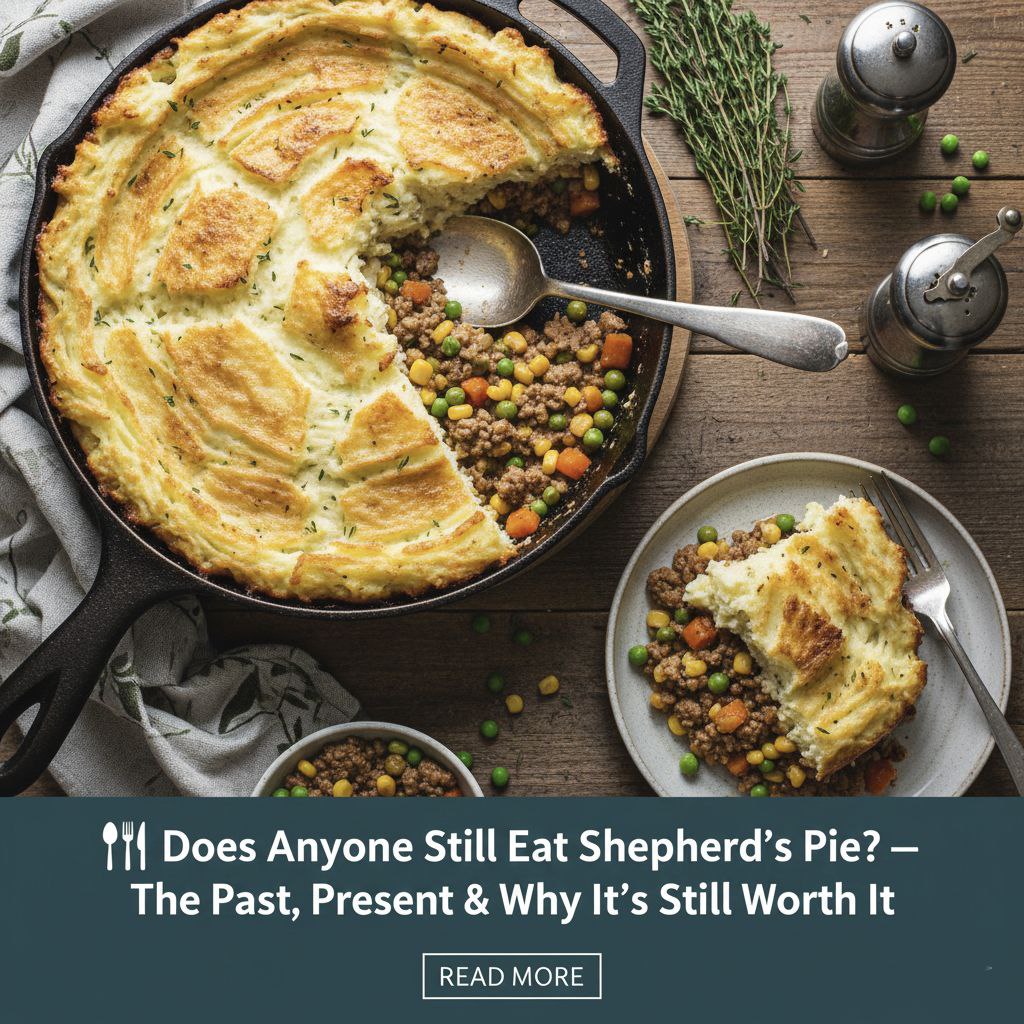
🌿 Introduction: Shepherd’s Pie — From Old Farm Kitchens to Our Plates
Once upon a time, a humble mash-and-meat dish from the British Isles earned its name from necessity, thrift, and simple home cooking. That dish was Shepherd’s Pie. Today, decades or centuries later, while fast food, global cuisines, and modern twists dominate dining tables — you may wonder: Does anyone still eat Shepherd’s Pie?
The answer is a resounding yes. But its role has shifted. From frugal comfort food to nostalgic comfort-food classic, Shepherd’s Pie remains beloved — though often with adaptations. In this article, we explore:
- The origins and history of Shepherd’s Pie
- What makes it a classic comfort meal
- A full updated recipe for modern kitchens
- Variations & modern twists
- Why it still deserves a place on dinner tables
- Tips for cooking, storage, and serving
Whether you grew up with Shepherd’s Pie or you’ve never tried it — this guide will renew your respect (and appetite) for the dish.
📖 A Brief History: Where Shepherd’s Pie Comes From
Origins in thrift and resourcefulness
- Shepherd’s Pie emerged in the late 18th to early 19th century as a clever way to reuse leftover roasted meat — often lamb or mutton — along with inexpensive potatoes. Over time, leftover meat would be chopped or minced, mixed with vegetables and gravy, and topped with mashed potatoes before baking.
- The name “Cottage Pie” was first used around 1791. That name reflected its roots among rural cottages and working-class households, where potatoes were abundant and meat was a precious commodity.
- By mid-1800s, the version using lamb or mutton came to be known as Shepherd’s Pie — a nod to the shepherds tending sheep. The mashed-potato topping (instead of pastry crust) made the meal affordable, filling, and easy to bake.
Why it spread so widely
- It was cheap and used staples: potatoes, leftover or inexpensive meat, basic vegetables — ideal for large families.
- No refrigeration meant using leftovers smartly. The casserole style — meat + gravy + topping — made it perfect for stretching limited food supplies across multiple meals.
- As people migrated and cultures spread, the concept of meat + mashed-potato bake traveled too — evolving with available meats, local veggies, and diets. Today’s “cottage pie,” “Irish Shepherd’s Pie,” or even vegetarian versions descend from the same root.
So yes — Shepherd’s Pie did begin as humble, frugal fare.
🥘 What Later Generations Changed — And Why Shepherd’s Pie Evolves
Over centuries, Shepherd’s Pie has adapted. What started as minced lamb with plain mash became something broader:
- Substitution of beef instead of lamb — spawning the term “Cottage Pie”. Beef was more accessible for some, and variants proliferated.
- Inclusion of vegetables: onions, carrots, peas, celery, sometimes even herbs or gravy-rich sauces — making it more balanced and flavorful.
- Use of fresh meat or leftovers — flexibility made it ideal for home cooks.
- Mashed potato topping became signature — creamy, comforting, and a universal favorite. Some even layer mashed potato below and above the filling.
- Over time, global variations emerged — vegetarian versions, use of other meats, more spices — making the dish adaptable to different cultures and dietary preferences.
In short: Shepherd’s Pie evolved from a poor-man’s dish to a widely loved comfort-food classic — admired for its simplicity, adaptability, and heartiness.
✅ Why People Still Eat Shepherd’s Pie (and Why It’s Still Relevant)
Here’s why Shepherd’s Pie remains in kitchens and on menus today:
- Comfort food at its best: Warm mashed potatoes, savory meat filling, vegetables — few dishes scream “home cooking” more.
- Affordable & filling: Great for families, leftovers, or budget-friendly cooking — feeds 4–6 easily.
- Adaptable to tastes & diets: Lamb, beef, turkey, vegetarian — you can choose. Add or skip veggies; adjust spices — it works.
- One-dish ease: Meat filling + mash topping + bake = minimal fuss, delicious reward.
- Nostalgia & tradition: For many — childhood memories, family dinners, Sunday meals. It connects generations.
- Global variations: Different countries and cultures have adapted it — making it timeless and universal.
So yes — not only does anyone still eat Shepherd’s Pie, many bakery-style pubs, home cooks, and comfort-food lovers around the world swear by it.
🍲 How to Make a Tasty, Updated Shepherd’s Pie at Home — Step by Step
Here’s a full recipe (updated for modern kitchens) for a delicious Shepherd’s Pie / Cottage-Pie — serves 4–6.
🛒 Ingredients
- 1 lb ground lamb (for authentic Shepherd’s Pie) — or ground beef (for cottage-pie style)
- 1 medium onion, finely chopped
- 2 cloves garlic, minced
- 1 cup carrots, diced
- ¾ cup peas (frozen or fresh)
- ½ cup celery (optional), diced
- 2 tbsp tomato paste (optional, gives depth)
- 1 cup beef or lamb broth (or stock)
- 1 tbsp Worcestershire sauce (adds umami)
- 1 tsp fresh thyme (or ½ tsp dried)
- Salt & pepper, to taste
Mashed potato topping:
- 1.5 kg potatoes (Russet or Yukon Gold)
- ⅓ cup milk (or more, for creaminess)
- 2 tbsp butter
- Pinch of salt
Optional / for richness:
- ½ cup shredded cheese (cheddar) — for cheesy top
- A handful of chopped parsley — for garnish
🔪 Instructions
STEP 1 — Prepare Potatoes & Mash
- Peel and chop potatoes into even chunks.
- Boil in salted water until tender (~15–20 min).
- Drain and mash with butter, milk and salt. Set aside.
STEP 2 — Cook the Meat Filling
- In a large skillet or pot, heat a bit of oil. Add chopped onion, carrots (and celery if using); sauté until softened (~5 min).
- Add minced garlic — cook 1 more minute.
- Add ground lamb (or beef). Brown thoroughly, breaking lumps with spoon. Drain excess fat if needed.
- Stir in tomato paste (if using), then add broth + Worcestershire sauce + thyme + salt/pepper.
- Add peas. Simmer ~8–10 minutes until mixture thickens (should be saucy but not soupy).
STEP 3 — Assemble & Bake
- Preheat oven to 400 °F (200 °C).
- In an oven-safe casserole dish, spread meat-vegetable filling evenly.
- Spoon mashed potatoes over the top — spread evenly. Use fork tines to create slight peaks (for crispy edges).
- Optional: sprinkle shredded cheese on top.
- Bake 25–30 minutes until potato top is golden and edges bubbling.
- Let rest 5 minutes before serving (the gravy will be very hot).
STEP 4 — Serve & Enjoy
Serve hot, ideally with a side salad, steamed veggies, or a simple green side.
🌈 Modern Variations & Twists
| Variation | What changes / adds | Why try it |
|---|---|---|
| Cheesy Shepherd’s Pie | Add cheddar cheese under or on top of mash | Extra richness & flavor |
| Turkey Pie (lighter) | Use ground turkey or chicken instead of lamb/beef | Lower fat, lighter dish |
| Vegetarian / Vegan Pie (Shepherdess Pie) | Use lentils / beans / mushrooms instead of meat; dairy-free mash | Plant-based, healthy, budget friendly |
| Sweet Potato Mash Top | Replace potatoes with sweet potatoes for topping | Nutty sweetness, richer vitamins |
| Spiced / Curried Pie | Add curry powder, cumin, spices to meat layer | Fusion twist — different flavor profile |
| Mixed-Veg Pie (Gluten Free) | Extra vegetables (peas, corn, carrots, zucchini), skip flour or thickener | Veggie-heavy & gluten-free friendly |
❤️ Why I Believe Shepherd’s Pie Will Always Have a Place
- It’s comforting — mashed potatoes, warm meat gravy, homey aroma — nothing beats it in winter or rainy days.
- It’s reliable — uses common, inexpensive ingredients; easy to adapt; forgiving if cooking skills are basic.
- It’s nostalgic — for many families, it’s a dish that evokes memories: Sunday dinners, childhood warmth, shared meals.
- It’s adaptable — from traditional lamb to vegetarian versions, from simple weeknight dinners to festive meals.
- It’s global — though British/Irish in origin, the concept resonates everywhere: mashed-topped meat bakes appear in many cuisines.
So even if it isn’t trendy or flashy, Shepherd’s Pie remains timeless.
⚠️ Common Mistakes & How to Avoid Them
| Mistake | What Happens | Fix / Tip |
|---|---|---|
| Over-boiling potatoes or using too much milk | Runny mash & soggy topping | Drain potatoes well; add milk/butter gradually |
| Using lean meat without enough fat or liquid | Dry filling | Use broth, veggies, or add a bit of oil during meat cooking |
| Not seasoning meat well | Bland pie | Taste and adjust salt/pepper before topping with mash |
| Over-baking after mash added | Dry surface, burnt top | Bake just 25–30 min; watch cheese or edges carefully |
| Serving immediately | Very hot gravy, burns | Let rest 5 min to settle filling |
🧊 Storage, Leftovers & Reheating
- Refrigerator: Store leftovers in airtight container — lasts 3–4 days.
- Freezing: Pie freezes well (without cheese topping) — good for 2–3 months. Thaw overnight in fridge before reheating.
- Reheating: Best done in oven at 350 °F (175 °C) until heated through; avoids soggy mash compared to microwave.
🏁 Conclusion: Yes — People Still Eat (and Love) Shepherd’s Pie
Despite modern culinary trends, fusion cuisines, and fast food culture — Shepherd’s Pie remains a timeless classic. It’s humble in origin, rich in history, and even richer in flavor. Whether you’re craving comfort food, feeding a family, or cooking on a budget — it checks all boxes.
Older generations may remember it as a frugal staple. Younger cooks may rediscover it for its versatility. And cooks everywhere will continue to reinvent it — with cheese, veggies, spices, or meatless versions.
So if you ever ask, “Does anyone still eat Shepherd’s Pie?”, the answer is loud, clear, and delicious: Yes — and we always will.
Let this article be your invitation to try, remake, and cherish this classic — because some dishes deserve to stay for generations.