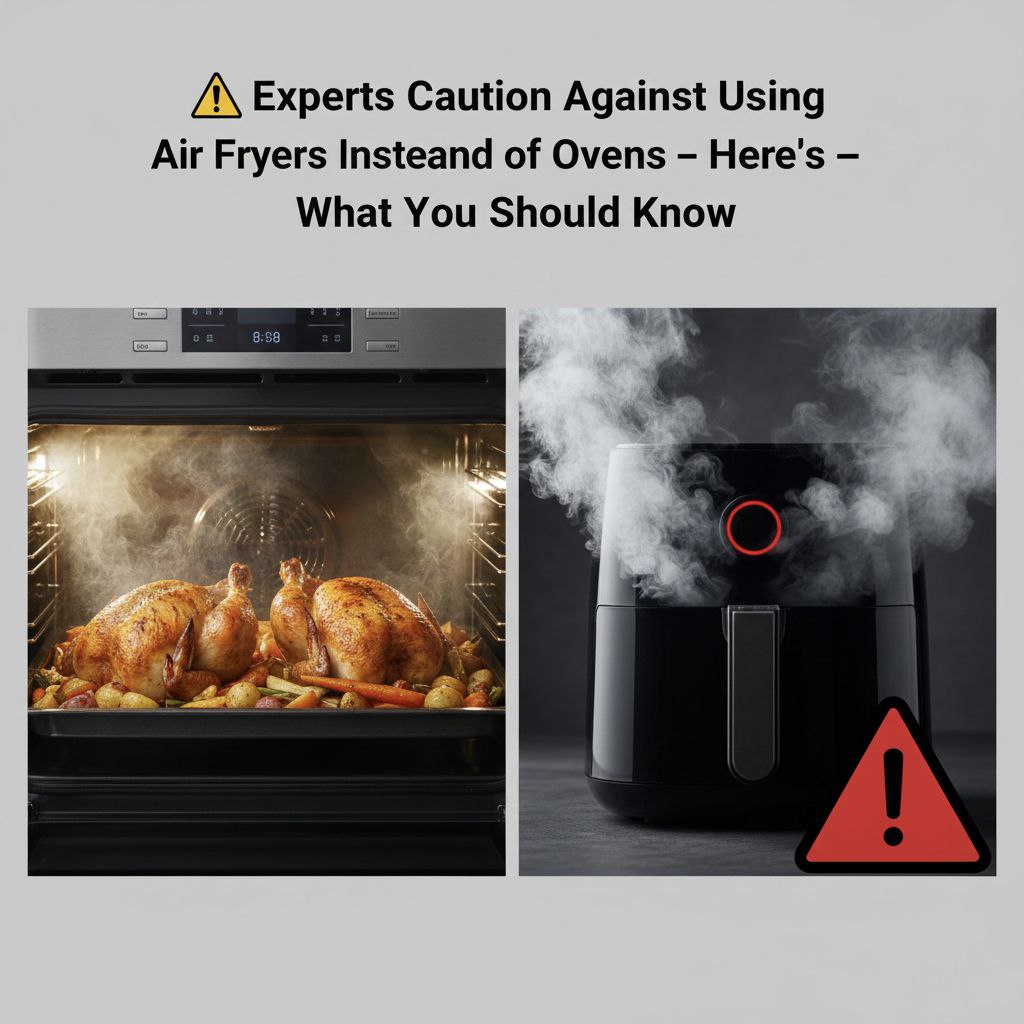
🏠 Introduction: The Kitchen Gadget Debate
The air fryer craze is everywhere — compact, fast, promising crispy results with less oil. Many people are ditching traditional ovens or using air fryers for almost everything. But experts are now raising caution about replacing your oven entirely with an air fryer.
Whether you’re living in a small space, trying to save energy, or love the convenience of an air fryer, this article will help you understand:
- Why experts say don’t rely only on an air fryer
- The key differences between air fryers and ovens
- Potential risks, limitations and practical concerns
- When an air fryer makes sense and when you’d be better off using the oven
- Smart tips for using your air fryer safely and effectively
At the end, you’ll have the knowledge to decide when to use each appliance and how to avoid common pitfalls.
🧰 What Is an Air Fryer — And How Is It Different from an Oven?
An air fryer is essentially a compact countertop convection oven with a powerful fan that circulates hot air rapidly around the food. Because of its size and design, it can reach high temperatures and cook faster than many traditional ovens.
A standard conventional oven (or a full-sized convection oven) has:
- A larger interior volume
- More even heat distribution (especially in quality ovens)
- Better capacity for large items, multi-rack cooking
- Slower pre-heat and longer cook times, but more flexibility for volume
In contrast:
- Air fryers have limited capacity and basket size
- They excel at small batches and items that benefit from very rapid air circulation
- Because of the strong airflow and concentrated heat, they may behave differently for large roasts, casseroles, or layered cooking
According to TechRadar, one expert says:
“Air fryers … rarely speed up food prepared on the stove — instead, they ensure the browning and crispness is more consistent… For food that takes around 20-25 minutes in an oven, reduce the cooking duration by around five to seven minutes …”
But the warning is, if you switch everything to the air fryer assuming it’s just as good as the oven for every job, you may run into trouble.
🚨 Why Experts Are Cautioning Against Using Air Fryers Instead of Ovens
1. Capacity and Batch Size Limitations
Air fryer baskets are designed for smaller volumes. If you try to cook large pans, whole turkeys, roasts, or multiple trays of food, you’ll:
- Overcrowd the basket → reduces airflow → uneven cooking
- Take many batches → lose convenience and time
A Reddit thread highlighted this:
“If you have to cook a large amount of food, use an oven because an air fryer … can’t handle it well.”
Thus for families or full-meal cooking, the oven still has an edge.
2. Energy Savings May Be Overhyped
For one-person meals or small batches, an air fryer might use less energy than pre-heating a huge oven. But expert money-saving advisor Martin Lewis warned that using an air fryer “instead of an oven” for dinner doesn’t always save money. He said:
“…If that’s being done for energy reasons, I would be somewhat sceptical whether that is a good idea.”
So if you rely on it all the time, the benefits may vanish.
3. Cooking Function & Versatility
Some dishes that benefit from slow roasting, layered cooking, baking large pans, or gentle heat may not work as well in an air fryer:
- Whole roasts may cook unevenly.
- Breads and baked goods may not rise or brown properly.
- Multi-rack baking or casseroles may be impossible due to size constraints.
As simplyrecipes cautions:
“Foods like whole roasts are better done in an oven—even the best air fryer can’t spread heat like a full-sized oven.”
4. Safety and Mechanical Risks
Air fryers have been subject to recalls and warnings due to overheating, poor build quality, and fire risks when misused. For example, a major recall affected over 287,000 units.
Also, improper use (oversized loads, poor airflow, inadequate cleaning) can lead to hazards.
5. Misleading Marketing & Overuse
Because air fryers market themselves as “fryer” alternatives and quick solutions, users may assume anything can be tossed inside and come out perfect. But as TechRadar notes, skipping pre-heat, overfilling baskets, using wrong oils or poor timing are frequent mistakes.
Such mis-application can give sub-par results and make people feel the device is unreliable.
🧭 When Is Using an Air Fryer Perfect? And When Should You Use an Oven?
✔ Ideal Uses for an Air Fryer
- Small batches of frozen foods (fries, nuggets, vegetables)
- Re-crisping leftovers quickly
- Cooking for one or two where you don’t want to heat the full oven
- Quick snacks or side dishes where speed and crispness matter
- Situations where the oven is unavailable or inefficient (small kitchen, dorm, RV)
✘ Best Uses for an Oven
- Full dinners involving multiple dishes or large trays
- Roasting whole birds, large cuts of meat, or baking large casseroles
- Delicate baking (bread loaves, large cakes) that benefit from stable, even heat
- Meals requiring multiple racks or long cooking times
- When you want consistent, even browning over large area
🧠 Practical Tips: How to Use Both Appliances Smartly
- Know the capacity of your air fryer: load size should allow air circulation.
- Pre-heat your air fryer if required — skipping this may lead to uneven texture.
- Do not replace your oven entirely unless you consistently cook only small batches.
- Cleaning matters: food and grease build-up in air fryers can reduce performance and increase fire risk.
- Convert recipes carefully: If you transfer an oven recipe to an air fryer, you may need to adjust temperature, time, and avoid thick pans that block airflow.
- Check for recalls or model limitations: Some older or cheaper units may have safety risks.
- Use the right tool for the job: multiple cooking appliances can coexist—air fryer for speed + crispness, oven for volume and versatility.
- Follow manufacturer instructions for max load, metal pans use, cleaning and ventilation.
📊 Comparison Table: Air Fryer vs Oven
| Feature | Air Fryer | Conventional Oven |
|---|---|---|
| Size / capacity | Small basket – ideal for 1–4 servings | Large interior – supports multiple trays |
| Heat source / circulation | Fan + concentrated heat, rapid airflow | Heating elements + optional fan; slower but more even |
| Pre-heat time | Short (2-5 min) | Longer (10-15 min) |
| Best for | Crisp snacks, single dishes, quick cooking | Large meals, roasting, baking, casseroles |
| Energy usage | Lower for small loads | More efficient for full oven loads |
| Versatility | Limited by size and heat distribution | High – supports many cooking methods |
| Cost & safety concerns | Some risk of misuse/overheating; recalls noted | Established safety; fewer appliance-specific recalls |
| User convenience | Quick, compact, countertop | Full-sized, longer cook & clean-up time |
🔍 Expert Warnings & Evidence
- Martin Lewis, UK money-saving guru, cautioned that using an air fryer “instead of an oven” may not save energy as widely believed.
- LadBible reported on warnings about hygiene, cleaning and cost related to air fryer usage.
- SimplyRecipes emphasised that certain foods (e.g., whole roasts) simply don’t perform well in air fryers.
- TechRadar listed multiple “common mistakes” with air fryer usage which may degrade results or safety.
These expert notes highlight the consensus: air fryers are fantastic gadgets — but not universal replacements for ovens.
🏁 Conclusion: Use Wisely, Don’t Replace Blindly
The takeaway: Don’t view your air fryer as always able to take the place of your conventional oven. Yes, it’s convenient, fast, and crisp-making. But it has capacity limits, functional boundaries, and safety/cost trade-offs.
Use your air fryer for what it does best: snacks, small meals, quick crisping. Use your oven for volume, versatility, large items and full-meal preparation. When you use both appliances smartly, your kitchen becomes more flexible and efficient — without compromise.
So next time you’re tempted to cook your entire dinner in the air fryer, stop for a moment: ask yourself if what you’re making is better served in the oven. And if you do use the air fryer, make sure you follow best practice: don’t overload it, pre-heat if needed, clean well, and match your cooking method to the food.
Your meals — and your appliance — will thank you.