💉 Introduction: The Story Behind the Famous “Vaccine Scar”
If you’ve ever noticed a small round scar on the upper arm of your parents or grandparents, you’ve probably wondered what it is. It’s not a birthmark, burn, or mole—it’s a smallpox vaccine scar, a silent badge from one of humanity’s greatest victories against disease.
For decades, this tiny mark symbolized protection against a deadly virus that claimed hundreds of millions of lives. Even though smallpox was officially eradicated in 1980, the scar remains one of the most recognizable reminders of the global fight against it.
In this article, we’ll explore what the smallpox vaccine scar looks like, how and why it forms, what makes it unique, and why people today no longer receive it.
🧬 What Is Smallpox and Why Was the Vaccine So Important?
Before we talk about scars, let’s understand the enemy that caused them.
Smallpox, caused by the Variola virus, was one of the deadliest diseases in history. It caused high fever, body pain, and a distinctive rash that turned into pus-filled blisters. Survivors were often left with severe scarring, blindness, or disfigurement.
By the 20th century, smallpox was killing 2 million to 3 million people every year. The discovery and mass use of the smallpox vaccine were revolutionary — it changed human history.
Thanks to global vaccination efforts led by the World Health Organization (WHO), the disease was officially declared eradicated in 1980 — the first infectious disease humans ever eliminated.
🩹 What Does a Smallpox Vaccine Scar Look Like?
The Classic Appearance
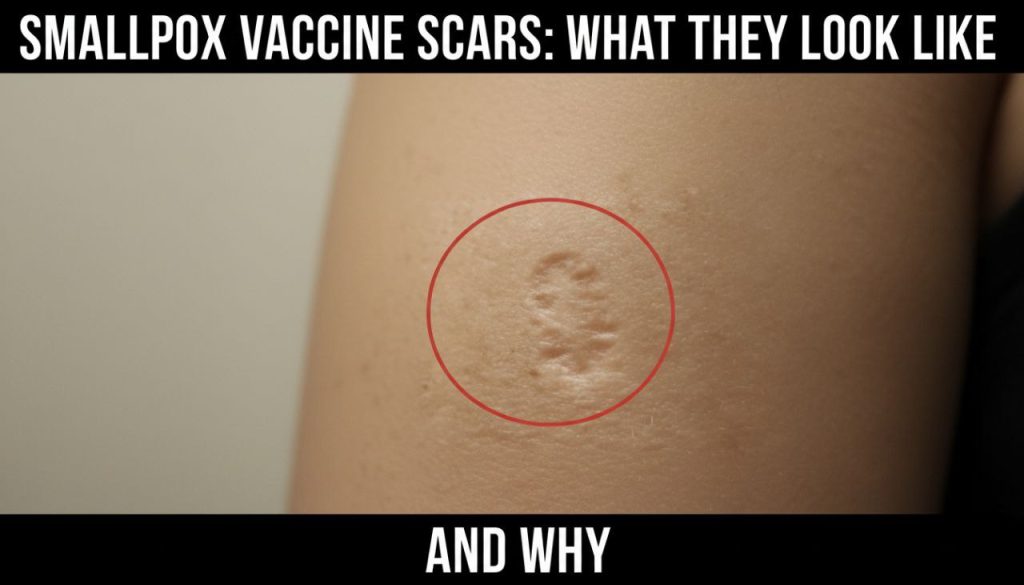
A smallpox vaccine scar usually appears as a round or oval depression in the skin, often about 5 to 10 millimeters wide. It is slightly lighter or darker than the surrounding skin and has a dimpled or crater-like texture.
Typically located on the upper left arm, this scar is smooth, flat, or slightly raised, depending on how your skin healed. Some scars are small and neat, while others appear as rough circular marks.
How It Changes Over Time
- First 3 days: After vaccination, a small red bump appears at the injection site.
- Days 5–7: The bump grows larger and forms a blister (pustule).
- Week 2–3: The blister oozes, scabs over, and begins to heal.
- Week 4–6: The scab falls off, leaving behind a shallow crater.
- Months later: A permanent round scar remains — the signature of the smallpox vaccine.
So, the mark people see today is the final result of that intense local immune reaction from decades ago.
🧫 Why the Smallpox Vaccine Leaves a Scar
Unlike modern vaccines that use a simple needle injection, the smallpox vaccine was administered using a bifurcated needle — a small two-pronged instrument dipped into a solution containing live vaccinia virus (a relative of smallpox).
Here’s why this method caused a scar:
- The vaccinia virus caused a controlled skin infection, which triggered a strong immune response.
- The localized infection led to a pustule (a raised blister filled with fluid).
- As the blister healed, it left behind scar tissue — a visible reminder that the vaccine had taken effect.
This process was actually proof that the vaccine worked. If you didn’t develop a blister, you were often re-vaccinated to ensure immunity.
🧠 Smallpox Vaccine vs. Other Vaccines: Why It’s Different
You might wonder why today’s vaccines don’t leave scars. The reason lies in how vaccines are administered.
| Vaccine Type | Delivery Method | Causes Scar? | Example |
|---|---|---|---|
| Smallpox | Multiple punctures with bifurcated needle | ✅ Yes | Smallpox (Variola) |
| BCG (Tuberculosis) | Intradermal injection | ✅ Often | Tuberculosis |
| Modern Vaccines (MMR, Hepatitis, Flu, etc.) | Intramuscular or subcutaneous injection | ❌ No | Measles, Flu, COVID-19 |
The smallpox vaccine intentionally caused a skin reaction so that the immune system could build strong localized and systemic immunity.
Modern vaccines, however, use refined methods that deliver antigens without causing major skin injury — that’s why we rarely see scars today.
🧬 What Virus Was Used in the Vaccine?
The smallpox vaccine did not contain the Variola virus (which causes smallpox). Instead, it used the Vaccinia virus, which is closely related but much milder.
When injected into the skin, the vaccinia virus triggered the body’s immune defenses. These antibodies and memory cells could then recognize and destroy smallpox if encountered in the future.
This approach — using a related but less dangerous virus — was a stroke of genius that originated with Edward Jenner in 1796. He famously used material from cowpox lesions to protect people from smallpox, leading to the term “vaccine” (from vacca, Latin for cow).
🌍 Why the Vaccine Scar Became a Global Symbol
By the 1950s–70s, smallpox vaccination campaigns covered nearly every country. Health workers used the bifurcated needle to vaccinate entire populations.
The result?
Millions of people — from Asia to Europe, Africa to the Americas — had the same small round scar on their arm.
That tiny mark became an international symbol of immunity and protection — a visible sign of survival in a world where smallpox had once been a death sentence.
💬 Common Questions About the Smallpox Vaccine Scar
1. Does Everyone Who Got the Vaccine Have a Scar?
Almost everyone did, but the size and appearance varied. Some scars are faint, while others are larger and more noticeable.
2. Is the Scar Dangerous?
No. The scar itself is harmless — it’s just healed tissue. There’s no live virus remaining after the wound heals.
3. Can the Scar Fade or Be Removed?
Over time, the scar may fade slightly, but it rarely disappears completely. Some people use laser or cosmetic treatments to reduce its appearance, but it’s generally harmless and doesn’t need treatment.
4. Why Don’t Young People Have the Scar Today?
Because routine smallpox vaccination stopped in 1980 after the disease was eradicated. Only certain laboratory workers handling the virus still receive the vaccine.
5. Can You Still Get Smallpox Today?
No. The virus has been eradicated, though samples are kept securely in two research labs (in the U.S. and Russia) for scientific study.
🩻 The Science of How the Scar Forms
When the vaccine virus replicates in skin cells, the body’s immune system launches a localized defense — inflammation, white blood cells, and tissue regeneration.
The process looks like this:
- Infection: Vaccinia virus enters skin cells.
- Immune response: Body attacks infected cells → swelling, redness.
- Blister formation: Fluid accumulates as the immune system battles the virus.
- Healing phase: Blister bursts, scabs, and tissue rebuilds.
- Fibrosis: New collagen forms, leaving a small, firm scar.
This natural healing response is what creates the classic round mark.
🧩 Smallpox vs. BCG Vaccine Scar — How to Tell the Difference
Many people confuse the smallpox scar with the BCG (tuberculosis) vaccine scar. Here’s how to distinguish them:
| Feature | Smallpox Scar | BCG Scar |
|---|---|---|
| Location | Upper left arm (often higher) | Upper shoulder or lower arm |
| Shape | Round, crater-like, dimpled | Smaller, smoother, less deep |
| Size | 5–10 mm | 2–5 mm |
| Year Given | Before 1980 | Still given in many countries |
| Caused By | Vaccinia virus | Mycobacterium bovis (BCG strain) |
So if your older relative has a deeper, more defined circular scar, it’s likely from smallpox, not BCG.
🌟 The End of Smallpox — and the Legacy It Left Behind
By the late 1970s, after decades of global vaccination, smallpox transmission was nearly zero. The last natural case was recorded in Somalia in 1977.
In 1980, the World Health Organization declared smallpox eradicated — one of the greatest achievements in medical history.
With the disease gone, routine vaccination stopped. But the scars remain — silent testaments to one of humanity’s greatest scientific triumphs.
Each small round mark is more than just a blemish — it’s a symbol of victory over one of the deadliest viruses ever known.
⚠️ Modern Relevance: Could Smallpox Return?
Even though natural smallpox is gone, concerns remain about accidental or deliberate release from lab samples. That’s why some military and laboratory personnel still receive the vaccine today.
However, for the general public, there’s no need for vaccination — the risk is virtually zero.
🏁 Conclusion: A Small Mark with a Big History
That tiny circular scar on an older person’s arm carries a huge story — of fear, science, resilience, and victory. It’s a mark of protection, not imperfection.
The smallpox vaccine scar stands as one of medicine’s most visible reminders that global cooperation, science, and courage can overcome even the deadliest diseases.
So next time you notice that little round dimple on someone’s arm — remember, it’s not just a scar.
It’s a symbol of human survival.